For decades, people believed IQ was fixed from birth — an invisible number that determined how intelligent someone would remain for the rest of their life. If you were born "smart," you stayed smart. If not, there was little you could do about it.
But modern neuroscience tells a far more interesting story. Today, scientists understand that the human brain is not static. It constantly changes, rewires itself, forms new neural connections, and adapts based on learning, environment, sleep, stress, nutrition, and mental activity. This ability is known as neuroplasticity.
“Intelligence is not simply something you are born with — it is also shaped by how you challenge and train your brain throughout life.”
So the big question remains: Can you actually increase your IQ? The answer is more complex than a simple yes or no. Some cognitive abilities can improve over time. Certain mental skills can be trained. Education and environment influence intelligence-related performance. However, researchers still debate whether someone's "core" IQ can dramatically change in adulthood.
What Does IQ Actually Measure?
Before asking whether you can increase cognitive ability, it helps to know what IQ tests attempt to measure. Standard instruments target several overlapping skills:
- Logical reasoning
- Pattern recognition
- Memory
- Processing speed
- Mathematical ability
- Verbal comprehension
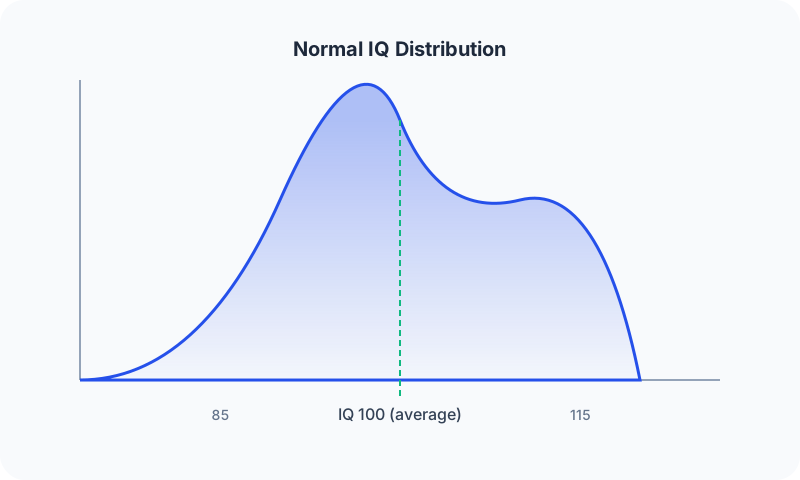
Most IQ tests are standardized so the average score is 100. Generally, 85–115 is considered average, 116–129 is above average, and 130+ reflects very high performance on the test — not a guarantee of life success. See our IQ score chart for ranges and percentile context.
100
Population mean on standardized IQ scales
15
Typical standard deviation (SD)
68%
Of people score between 85 and 115
The Brain Is More Flexible Than Scientists Once Thought
Modern neuroscience discovered the brain can physically change throughout life. When people repeatedly learn difficult skills, neurons strengthen their connections — a process central to whether IQ can improve with sustained effort.
Similar patterns appear in musicians, chess players, bilingual individuals, and experts in spatial navigation. The takeaway: your brain responds to what you practice — not just in childhood, but across the lifespan.
The Flynn Effect: Proof That IQ Scores Can Rise Over Generations
One of the strongest arguments against fixed intelligence is the Flynn Effect — the observation that average IQ scores increased across many countries during the 20th century. That trend suggests environment plays a major role in cognitive performance, even if the effect has slowed or reversed in some regions recently.
- Improved education and literacy
- Better nutrition and healthcare
- Greater exposure to technology and abstract thinking
- More cognitively demanding work and leisure environments
Can Brain Training Apps Increase IQ?
Brain-training apps became extremely popular, promising to improve intelligence in minutes a day. Scientific results, however, are mixed. Most studies show users improve at the exact tasks they practice — but those gains do not always transfer to general reasoning on unrelated tests.
Researchers distinguish near transfer (improvement on similar puzzles) from far transfer (improvement on entirely different cognitive tasks). Mentally stimulating activities may still support long-term brain health — they are just not magic IQ pills. For honest practice, try our sample IQ questions and review explanations after each attempt.
Education and Intelligence: Can Schooling Raise IQ?
Education strongly affects IQ-related performance. Schooling trains abstract thinking, memory, problem solving, and information processing — skills that show up directly on many test items. Research consistently shows additional years of education correlate with higher scores on standardized cognitive batteries.
If you are comparing scores across years, read our guide on average IQ by age to keep developmental context in mind — children and teens often show larger shifts than adults.
Sleep and Cognitive Ability: The Overlooked IQ Factor
Sleep is one of the most overlooked factors affecting brain performance. Poor sleep reduces focus, reaction time, memory, and learning ability — which means you may score lower on a reasoning test after a bad night even if your underlying skills are unchanged.
- Deep sleep supports memory consolidation
- Sleep deprivation impairs working memory and attention
- Consistent sleep schedules improve day-to-day mental clarity
- Recovery sleep after deprivation can restore performance toward your baseline
Exercise and Brain Health
Physical activity increases blood flow to the brain and stimulates chemicals associated with neural growth. Studies link regular exercise to better attention, executive function, processing speed, mood, and memory — all of which influence how sharply you perform on reasoning tasks.
Exercise also reduces chronic stress, which independently harms cognition. Even brisk walking several times per week can support the mental clarity you need for learning and problem solving.
Does Reading Make You Smarter?
Reading exercises multiple brain systems simultaneously. It improves vocabulary, comprehension, focus, imagination, and analytical thinking. Complex fiction and non-fiction both act as workouts for the brain — building the verbal and conceptual tools that appear on many IQ subtests.
“Readers do not just collect facts — they build mental models of how the world works.”
Stress and Intelligence
Chronic stress harms cognitive performance. Long-term elevated cortisol may impair memory, learning, concentration, and emotional regulation. Managing stress through exercise, meditation, sleep, and social connection can improve the mental clarity that supports test performance and daily decisions.
Does IQ Change Over Time? Are IQ Scores Permanent?
This is the heart of the question can IQ improve for real individuals — not just populations. IQ scores are relatively stable but not completely fixed. Researchers generally agree genetics matter, environment matters, cognitive skills can improve, and brain performance changes over time.
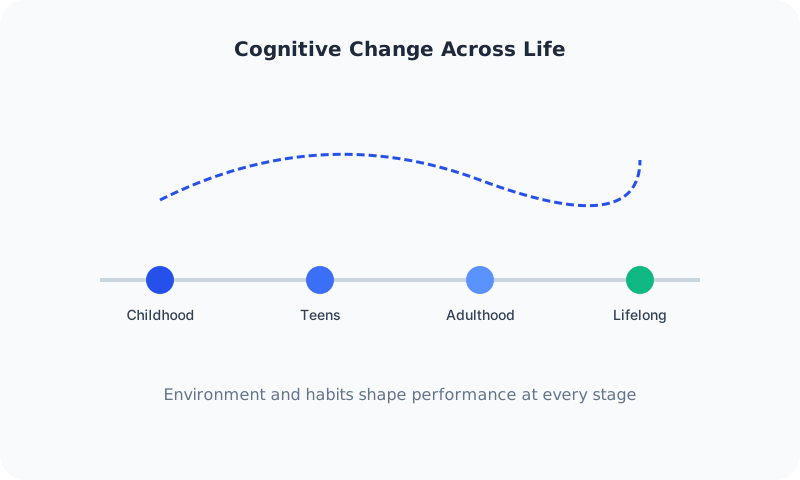
- Children & teens: Brains are still developing — larger score shifts are possible.
- Adults: Full-scale jumps are rarer, but reasoning performance can still improve with practice and lifestyle.
- Older adults: Maintenance through activity, social engagement, and health matters for preserving function.
Wondering how online quizzes fit in? Read are online IQ tests accurate for an honest look at validity — and remember that FreeIQCheck scores are illustrative, not clinical.
Final Thoughts: Can You Increase Your IQ in 2026?
Science suggests certain aspects of cognitive performance can improve through education, sleep, exercise, mental stimulation, and healthy lifestyle habits. The human brain is far more adaptable than scientists once believed.
While genetics influence intelligence, environment and daily habits also play an important role. Intelligence is not simply something you are born with — it is also shaped by how you challenge and train your brain throughout life.