When people search for a free IQ test online today, they usually want a fast score and a shareable result. What they rarely see is the long scientific road that made such tests possible—from a Paris school commission worried about struggling students to global debates about fairness, genetics, and what “intelligence” even means.
The evolution of IQ testing is not a straight line of progress. It includes genuine breakthroughs in measurement, embarrassing misuses in education and immigration policy, and ongoing efforts to build fairer, more useful tools. Understanding that history helps you interpret modern scores—whether from a clinician or from a site like FreeIQCheck.
“Every IQ score is a snapshot taken with a particular ruler, on a particular day, for a particular purpose.”
Before “IQ”: A Practical Problem to Solve
Long before anyone asked who invented the IQ test, educators noticed that children of the same age varied enormously in classroom readiness. Some mastered reading quickly; others needed individualized support. The question was practical: how could schools identify students who needed extra help without relying on vague teacher impressions alone?
Nineteenth-century researchers experimented with sensory tasks, reaction time, and memory drills, hoping to measure a single underlying “mental energy.” Many of those early efforts failed to predict school success. The breakthrough came when psychologists stopped chasing a mystical general faculty and instead built tasks that looked like the reasoning problems children actually faced in class.
1905: Alfred Binet and the Binet-Simon Scale
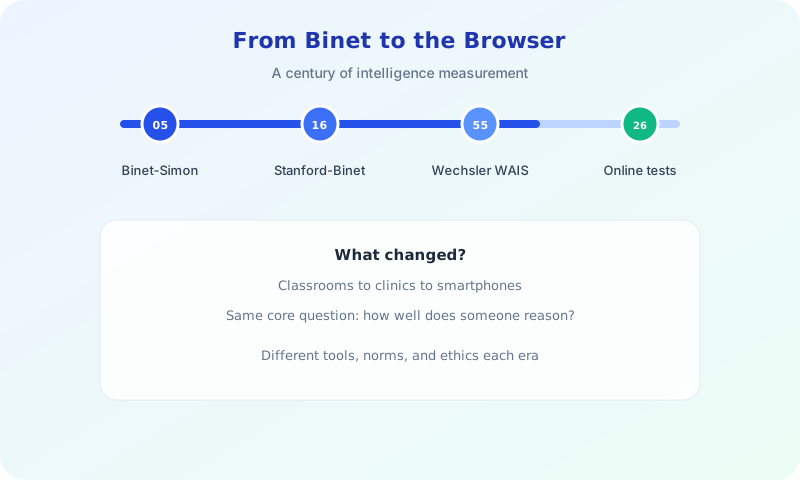
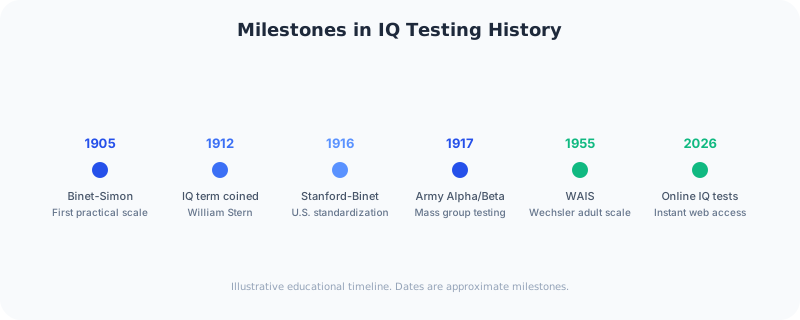
In 1905, French psychologist Alfred Binet and physician Théodore Simon published a scale designed to spot Parisian schoolchildren at risk of falling behind. The Binet-Simon test was not a label-making machine—it was a diagnostic screen. Tasks included following directions, repeating sentences, and solving simple logic puzzles arranged by difficulty.
Binet believed intelligence was complex, shaped by environment, and improvable with training. He would likely be uncomfortable with how later generations turned his tool into a single number ranking people for life.
1912: The “Intelligence Quotient” Is Born
German psychologist William Stern proposed dividing mental age by chronological age and multiplying by 100, creating the familiar IQ formula. A child with a mental age of 12 at age 10 would earn a ratio of 120—above average for that comparison group.
1916: Terman and the Stanford-Binet in America
Stanford psychologist Lewis Terman adapted and standardized the Binet-Simon for American children, publishing the Stanford-Binet in 1916. He introduced large norm groups, revised item content, and popularized wide-scale testing in schools. The Stanford-Binet helped establish intelligence testing as a mainstream educational tool in the United States.
Terman also launched longitudinal studies following high-scoring children for decades—work that still informs debates about whether early scores predict adult achievement. (Spoiler: they correlate, but they do not dictate life outcomes.)
World War I: Army Alpha and Army Beta
When the United States entered World War I, the military needed to screen more than a million recruits quickly. Psychologists led by Robert Yerkes developed the Army Alpha (written exam) and Army Beta (nonverbal tasks for recruits with limited literacy or English). This was among the first mass administrations of intelligence-style tests.
- Army Alpha: Verbal analogies, arithmetic, and general information—timed group testing.
- Army Beta: Picture completion, maze tracing, and pattern tasks for less literate recruits.
- Legacy: Proved large-scale psychometrics was feasible—and raised early fairness concerns about language and culture bias.
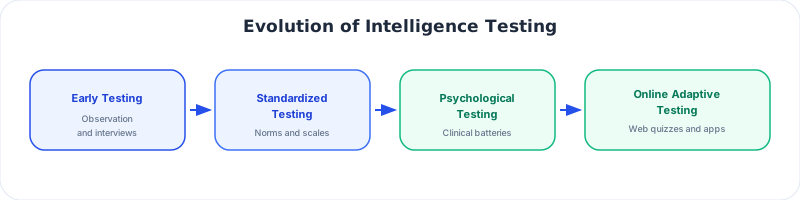
1955 and Beyond: Wechsler and the Modern Battery
Clinical psychologist David Wechsler argued that intelligence was not a single number but a profile of interrelated abilities. His Wechsler-Bellevue scale (1939) evolved into the Wechsler Adult Intelligence Scale (WAIS), with a widely used 1955 revision anchoring modern adult testing. Separate child versions (WISC) followed.
Wechsler batteries report a full-scale score plus index scores—verbal comprehension, perceptual reasoning, working memory, processing speed—giving clinicians a richer picture than one headline number. That structure still influences how psychologists think about cognitive profiles today.
100
Mean score on Wechsler scales
15
Standard deviation (most editions)
4+
Major index scores on full batteries
Standardization, the Flynn Effect, and Ongoing Debates
As modern IQ tests spread through schools, workplaces, and clinical practice, psychometricians refined norms, reliability studies, and validation research. They also confronted misuse: eugenics movements, discriminatory immigration policy, and overconfident claims about racial differences that reflected test bias more than biology.
Researchers documented the Flynn Effect—rising average scores across generations in many countries—suggesting environmental factors like schooling and nutrition influence measured intelligence. Debates continue about how much scores reflect innate ability versus opportunity, and how to design fairer items.
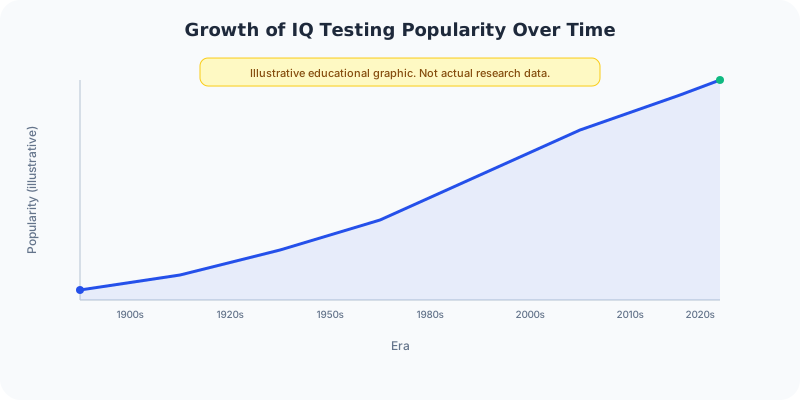
2026: Online IQ Tests and Instant Access
Today, anyone with a smartphone can take an online IQ test in minutes. Web quizzes sample matrix reasoning, sequences, vocabulary, and spatial puzzles—item types descended from century-old subtests. Platforms like FreeIQCheck emphasize education and practice: illustrative scores, explanations, and no email gate on our no-email test page.
The shift from clipboard to browser changed what testing optimizes for: speed, accessibility, and engagement. It also blurred the line between clinical assessment and entertainment. Responsible sites disclose limits. For an honest look at validity, read are free IQ tests accurate.
Where IQ Testing Goes Next
Emerging trends include adaptive testing (items that adjust difficulty in real time), gamified cognitive tasks, and integration with neuroscience measures like reaction-time distributions and working-memory paradigms. Ethicists push for transparency about data use, cultural fairness, and the dangers of reducing people to a single score.
Meanwhile, research on whether you can increase your IQ and how daily habits reflect thinking styles reminds us that measured intelligence interacts with education, sleep, motivation, and opportunity—not just test items.
What the History Teaches Us
The history of IQ tests is a story of tools built to solve real problems—identifying struggling students, staffing armies, diagnosing learning disorders—later stretched beyond their evidence. The best use of any score, online or clinical, is informed: know what was measured, who normed it, and what you should not conclude.