People have argued about the origins of intelligence for centuries. Some insist that cognitive ability is mostly written in DNA — a gift you either receive or do not. Others point to poverty, schooling, nutrition, and stress as the real architects of who succeeds on tests and in life. Modern behavioral genetics offers a more precise answer than either extreme: intelligence is influenced by both genes and environment, and the balance between them shifts depending on age, context, and what exactly you measure.
When researchers ask is intelligence genetic, they are usually studying heritability — the proportion of differences in test scores among people in a given population that correlates with genetic differences. That is not the same as saying your personal IQ is "80% genetic." Heritability describes variation across a group at a point in time, not an individual destiny. Still, the science is clear that inherited biology plays a meaningful role — and so does everything that happens after birth.
This guide explains how much of IQ comes from genetics versus environment, what twin studies reveal, whether IQ can be inherited, and why there is no single "IQ gene." If you want a practical snapshot of your reasoning skills after reading, try our free IQ test with no email — an educational quiz, not a clinical assessment.
“Genes set constraints and tendencies; environments decide which potentials get exercised. Intelligence is never purely one or the other.”
What Does "Genetic" Actually Mean in IQ Research?
Before diving into percentages, it helps to define terms. Heritability (often written as h²) estimates how much of the differences in IQ scores in a population can be statistically linked to genetic variation. If heritability is 0.50 in a study, it does not mean half of your intelligence came from DNA. It means that, in that sample, about half the spread between people's scores is associated with genetic differences.
Researchers infer this using several methods. Twin studies compare identical twins (who share nearly all their genes) with fraternal twins (who share about half, like ordinary siblings). If identical twins are more similar in IQ than fraternal twins — especially when raised apart — genetics is implicated. Adoption studies compare adopted children to their biological and adoptive parents. When children resemble biological relatives they never met more than the families that raised them, genes again enter the picture.
How Much of Intelligence Is Genetic?
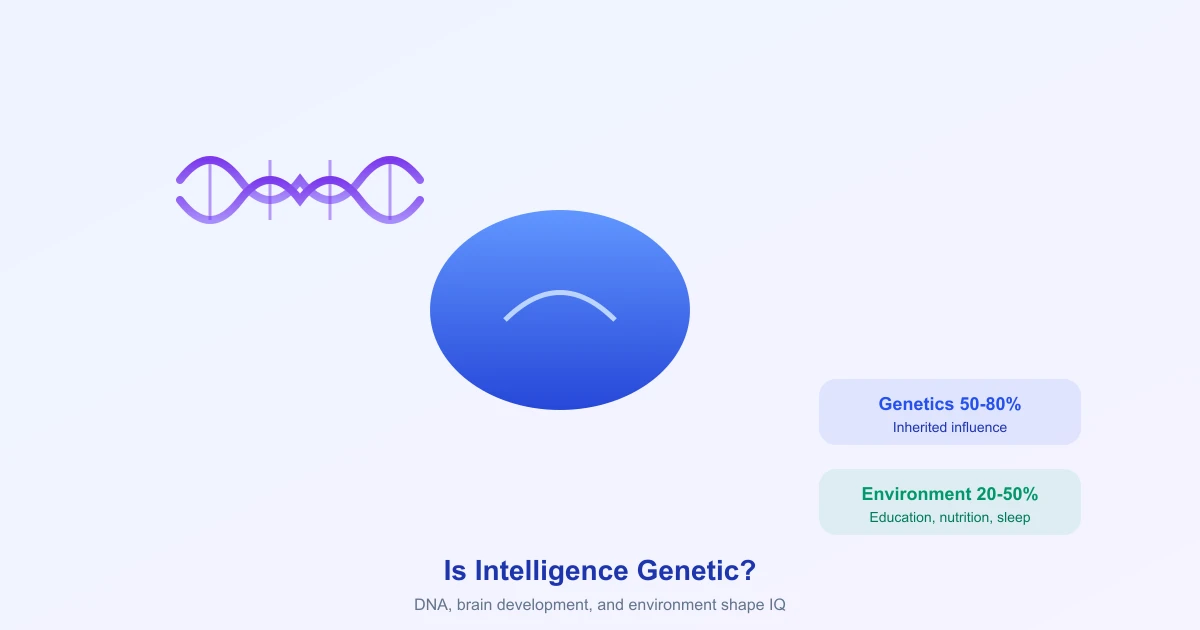
Meta-analyses of twin and adoption studies typically place the heritability of IQ in a broad range — often roughly 50% to 80% in affluent Western samples, with the rest attributed to environmental factors and measurement error. The exact number varies by age: heritability tends to be lower in early childhood and higher by adolescence and adulthood, as people gain more freedom to seek environments that match their interests and abilities.
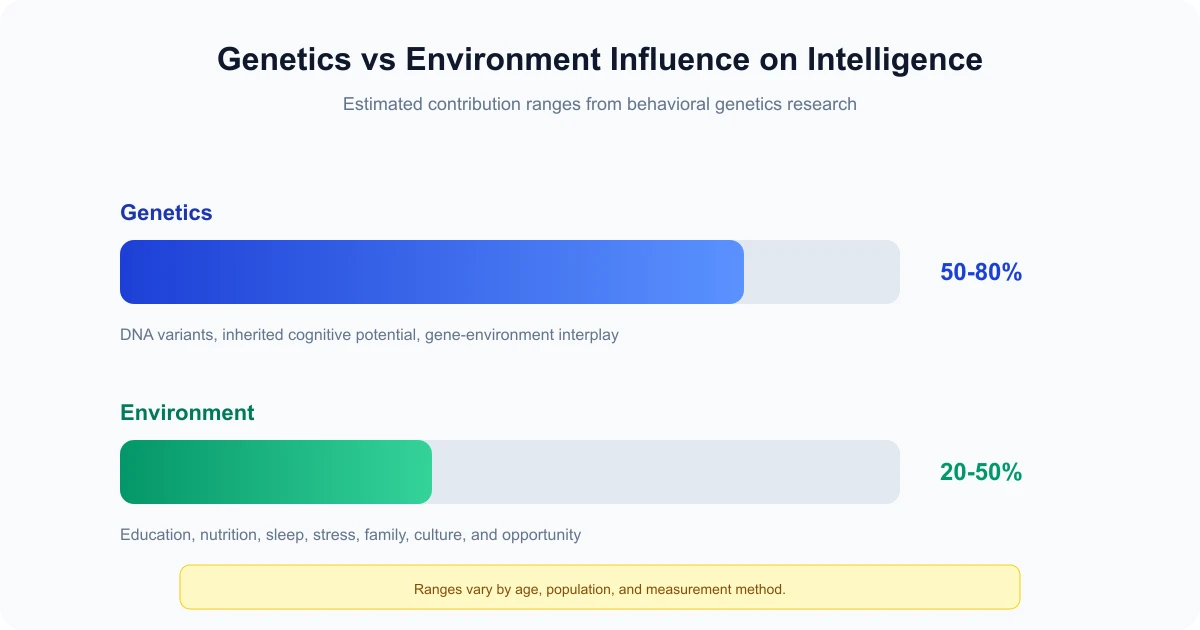
Environmental contributions — often estimated at 20% to 50% in the same frameworks — include quality of schooling, literacy exposure, nutrition, sleep, chronic stress, toxins such as lead, and socioeconomic opportunity. In populations where everyone shares similar schools and healthcare, heritability estimates can rise not because genes matter more in absolute terms, but because environmental differences have shrunk.
50–80%
Typical heritability range in twin-study meta-analyses
20–50%
Environmental & unique experience contributions
1000s
Of genetic variants linked to cognition — no single IQ gene
Genes, Brain Development, and Environment Work Together
DNA does not code for a number on an IQ test. It influences how neurons wire, how efficiently the brain processes information, working-memory capacity, processing speed, and vulnerability to certain developmental disruptions. Those biological starting points then interact continuously with experience. A child with strong verbal aptitude who grows up in a language-rich home will differ from an equally gifted child denied books or stable sleep — even if their genotypes overlap.
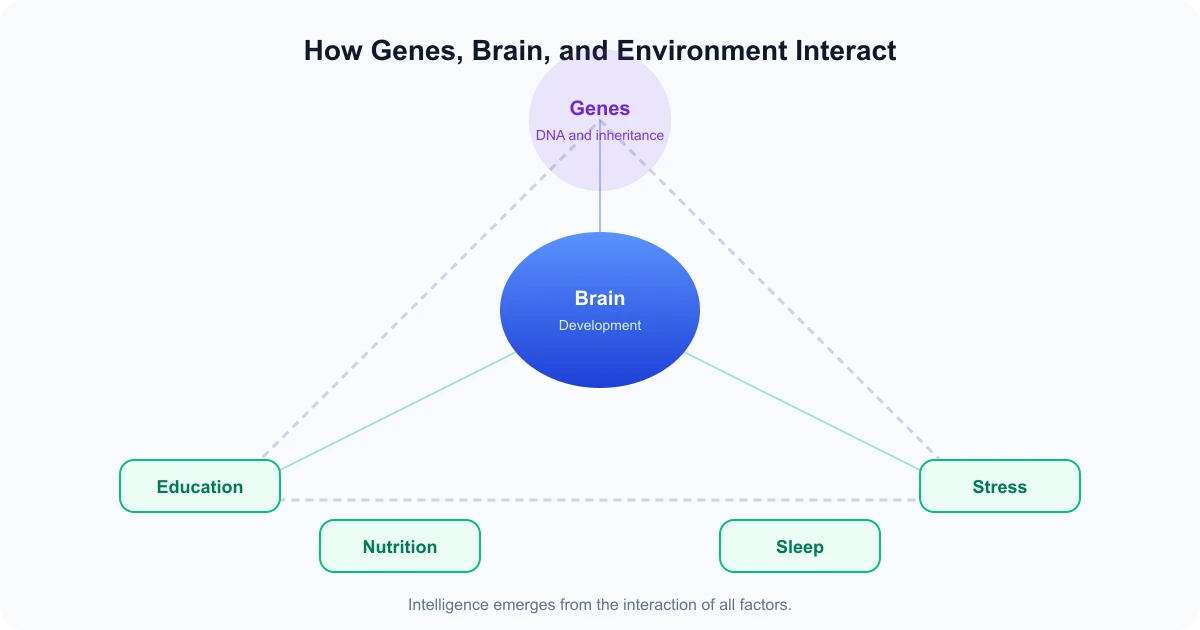
- Genes — Thousands of common variants each contribute tiny effects; rare mutations can have larger impacts in specific cases.
- Education — Schooling builds vocabulary, abstract reasoning, and test familiarity; quality and duration matter.
- Nutrition — Adequate calories, iron, iodine, and prenatal care support healthy brain development, especially early in life.
- Sleep — Consolidates memory and attention; chronic deprivation lowers cognitive performance on tests and in class.
- Stress — Persistent adversity, trauma, and instability can suppress working memory and learning — sometimes for years.
Is IQ Inherited? What Family Studies Show
Yes — to a meaningful degree. IQ is partly inherited in the statistical sense: biological parents and children, and especially siblings and identical twins, resemble each other more in test performance than chance would predict. Adoption studies reinforce the point: adopted children correlate more strongly with biological parents they never lived with than with adoptive parents who raised them, though adoptive families still influence education and opportunity.
That does not mean IQ is determined by genetics alone. Shared family environment — books at home, parental expectations, tutoring, nutrition — still explains part of sibling similarity, especially before adolescence. As children age, non-shared experiences (different friends, teachers, illnesses, hobbies) increasingly differentiate even twins.
Is There an "IQ Gene"?
No — not in any simple sense. Genome-wide association studies (GWAS) have identified many thousands of genetic variants associated with cognitive performance and educational attainment, each contributing a very small effect. Polygenic scores — which combine these variants — can predict small amounts of variance in test performance across large samples, but they are far too weak to determine any one person's ability.
Rare genetic conditions — certain chromosomal disorders or severe mutations — can dramatically affect cognitive development, but those cases are exceptional. For most people, intelligence reflects the cumulative influence of countless common variants interacting with a lifetime of environments. Searching for a single "smart gene" is a category error.
How Environment and Education Shape Measured IQ
Environmental effects are largest when environments are harsh or unequal. Remediating iodine deficiency, reducing childhood lead exposure, expanding mandatory schooling, and improving early literacy have all been linked to measurable gains in cognitive test performance at the population level. James Flynn's research documented generational IQ rises too large to attribute to faster evolution — the cause must be environmental change.
For individuals, quality education builds crystallized intelligence — vocabulary, general knowledge, and learned problem-solving strategies — which many IQ tests partially capture. Intensive early interventions in disadvantaged communities have produced lasting score gains in some randomized trials, though effects vary. Read more about whether personal scores can move in our guide on can you increase your IQ.
Daily habits also matter. Sleep, curiosity, reading, and mental challenge support the same cognitive systems many tests sample. See habits linked to high intelligence for behaviors associated with flexible thinking — and remember that habits themselves are partly shaped by opportunity and stress load.
What IQ Tests Can and Cannot Tell You About Genetics
IQ tests measure performance on specific tasks at a specific time. They correlate with academic and occupational outcomes in research samples, but they omit creativity, practical wisdom, social skill, and grit. When people ask is IQ determined by genetics, they often assume a test score reveals immutable biological rank — it does not. Scores include error, motivation, anxiety, language familiarity, and cultural content bias.
The history of IQ testing includes misuse in eugenics and discriminatory policy — reasons to interpret heritability research carefully and ethically. Modern scientists emphasize that group differences in average scores across demographic categories cannot be simplistically blamed on genetics; structural inequality, test bias, and educational access explain much of observed disparity. For context on what online tools actually measure, read are free IQ tests accurate and our overview of the evolution of IQ testing.
The Balanced Takeaway: Nature and Nurture Both Matter
So — is intelligence genetic? Yes, substantially. Can IQ be inherited? Partly, in the same way height, temperament, and disease risk are inherited — through complex polygenic inheritance, not a single switch. How much of intelligence is genetic? In typical twin-study frameworks, often roughly half or more of population variance in affluent samples — with environment, luck, and measurement error accounting for the rest, and with ranges that shift by age and society.
The practical lesson is neither fatalism nor blank-slate denial. Genes influence aptitudes and constraints; environments determine whether those aptitudes meet books, teachers, sleep, and safety. Measured IQ sits at that intersection — a useful research construct, not a complete portrait of a mind.
If you want to explore your current reasoning skills in a low-stakes way, take the free IQ test on FreeIQCheck. Treat the result as an educational snapshot — one moment in the ongoing conversation between your biology and your experience.